


Most conversations about AI in private markets focus on abstracts: “Which tools?” “Which models?” “What’s the risk?”
The more useful question is: “What are firms actually doing with it, and what problems does it solve?”
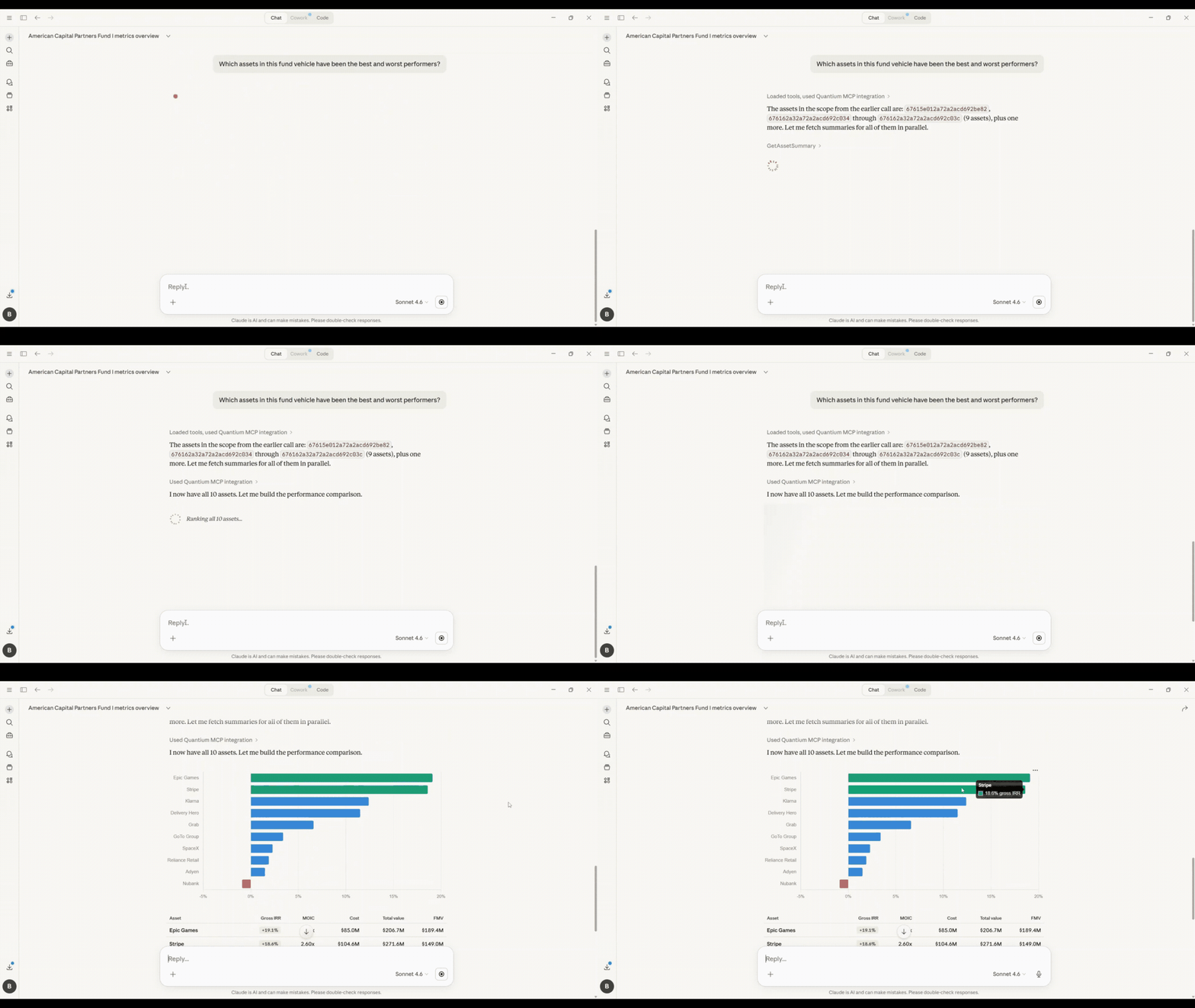
At Quantium, a growing number of GPs and fund administrators are putting AI to work on their fund data by connecting it to enterprise AI tools through our MCP server, and through AI working within Quantium itself. In this blog, we discuss four ways firms are using AI on their live fund data.
These practices are early in their adoption curve, but they are not hypothetical. The GPs in the examples below are running them in production today, within the security and compliance boundaries their investors and regulators expect.
1. Replacing the “ask Finance” loop
Emerging use case: Natural-language analysis across funds, entities, and portfolios
A surprising amount of work inside private markets firms starts with deceptively simple questions: “What changed? Which assets moved? Which funds are not on track? What’s driving performance this quarter?”
These questions rarely sit neatly inside a standard dashboard or recurring report pack. Answering them traditionally means pulling data from multiple sources, exporting to Excel, and waiting for someone with the right technical or financial context to assemble them into the full picture. It works, but the process is so cumbersome that it makes ad hoc analysis slower than it should be. It creates a queue of requests that stalls the teams asking them.
With live structured data connected through Quantium’s MCP server, the game changes. Users can query across funds, entities, investors, transactions, and portfolios in plain English, without a predefined report required, and refine the question as they go – the way they would in a conversation. Critically, access is governed: users querying through AI see only the data their Quantium permissions entitle them to see.
One of our venture capital clients wanted their senior partners to have direct visibility into fund and portfolio data without routing every question through Finance. By connecting Quantium’s API to their own Claude instance via the MCP server, partners can now interrogate live fund data from desktop or mobile:
- “How is Fund III tracking against benchmark?”
- “What’s current NAV across the portfolio?”
- “Which positions moved most this quarter?”
Finance is still the source of truth – but AI helps give the right people access to the data, and improves the speed at which they can get it.
2. Rebuilding an investor report through AI
Emerging use case: Investor report generation from structured fund data
One of our clients – a European private credit firm managing over $1 billion in AUM – had a different problem. Their investor report format worked; their LPs were comfortable with it, and they had no interest in replacing it. The challenge was the manual effort that went into producing it.
Their solution: centralize fund data in Quantium and connect it to Claude through Quantium’s MCP server, using it as the source layer for generating reports, replicating their existing report format, populated with verified Quantium data.
This is the use case that generates the most scepticism, and understandably so. Investor reports carry real consequences; accuracy is non-negotiable. The question we hear most often is whether AI-generated output can be trusted when the numbers matter.
The firm’s setup answers it directly. Because Claude reaches the data through the MCP server, drawing on Quantium’s structured data layer rather than unstructured inputs, the output is grounded in the same figures the Finance team works from. The format is replicated; every data point is verifiable back to source. That traceability matters as much for compliance as it does for accuracy. When an LP or auditor asks where a number came from, the answer is the same system of record it has always been.
While this method won’t be the right approach for every firm, it’s an early proof point that AI-assisted investor reporting – built on the right data infrastructure – is a viable operational model today.
3. Adding a first-pass review layer to finance and operations
Emerging use case: Exception monitoring, reconciliation review, and booking error detection
Fund operations teams review enormous volumes of transactions, cash movements, and reporting outputs. The hard part isn’t the volume – it’s catching the small inconsistencies before they become downstream problems. A wrong payment date, an unexpected allocation, an unmatched cash receipt, or a journal that looks directionally off can result in (completely avoidable) major reworks if detected too late.
The pattern we see emerging is that firms are using AI on live transaction and cash data to run the first-pass checks that previously required extensive manual review:
- “After an investor transfer, do the reallocated commitments and capital account balances tie out across every affected account?”
- “Are the amounts in this capital call notice pro rata to each LP’s unfunded commitment?”
- “Which cash movements this month remain unmatched against expected receipts?”
The AI is not acting as an accounting control, therefore it doesn’t need editing access to do this work – its job is to read and to flag, and the final decision is made by a person. AI’s role is to reduce manual scanning by producing a shortlist for human review; the finance team still determines what’s explainable and what needs correcting. The outcome is less line-by-line checking, and issues surfacing weeks earlier than they otherwise would in the reporting or audit cycle.
4. Answering LP ad hoc requests and questionnaires
Emerging use case: Extracting investor-specific data on demand
All IR and finance teams know the rhythm of LP requests – a pension fund needs its capital account data in a specific template for its own reporting. A fund-of-funds sends an annual questionnaire asking for commitment, drawdown, distribution, and NAV history in their format, not yours. A consultant wants net IRR for one investor’s position, calculated to a specific date.
While none of these requests is difficult individually, the burden lies in the aggregated workload; each request requires someone to pull investor-level data out of the system, reshaping it to match the requester’s format, and checking it before it goes out. As the LP base grows, so does the queue.
Because Quantium holds investor-level data as structured records – commitments, capital calls, distributions, NAV, fees, carry – teams are starting to use AI to do the extraction and reshaping step directly:
- “Pull LP X’s capital account activity for 2025.”
- “Populate this questionnaire with Fund II’s investor-level cashflows.”
- “What’s this LP’s net position across all vehicles as of quarter-end?”
The person reviewing the output is still accountable for what gets sent to an investor – that doesn’t change. What changes is that assembling the answer takes minutes instead of a data export and an afternoon, and the figures come from the same source of truth the Finance team closes against, not a side spreadsheet.
Security and compliance: the question that comes before use cases
Every one of these conversations starts in the same place. Not “what can AI do,” but “where does our data go, and who can see it?” That’s the right question to ask, and the use cases above only exist because it now has a good answer.
The firms deploying today share a few things in common. Fund data never leaves governed infrastructure – AI tools connect through Quantium’s MCP server into enterprise AI environments with contractual protections on data retention and model training, not consumer tools. Access follows existing entitlements, so users querying through AI see only what they could already see inside Quantium. Every answer is grounded in the structured data layer, which means figures trace back to the system of record instead of an unverifiable synthesis. And in each of these use cases, AI narrows, drafts, or flags. People decide.
AI adoption in private markets will move at the speed of compliance comfort. The firms moving first aren’t the ones taking the most risk – they’re the ones who don’t have to take any. Their data governance already does the work, so adopting AI doesn’t mean rewriting the rules around who sees what.
The pattern behind the emerging use cases
These examples are a fraction of what firms are beginning to do with AI on live fund data – and they share one thing in common. None of them started with a model. They started with structured data.
That’s the real divide between firms still evaluating AI in the abstract and firms deploying it against operational problems: how well their data is organised. Quantium was built to fix exactly this. Structured, AI-ready data is the foundation of how we’ve integrated AI into our software – which means our customers aren’t starting from scratch when they want to connect an AI tool to their fund data. The infrastructure is already there – they plug in and go.
Curious what AI could look like in practice for your firm? We work with leading GPs and fund administrators and are happy to walk through real-world examples relevant to your operations. Get in touch at enquiries@quantium.pe or request a demo.