



Smartfin
Private Equity
Bringing complex waterfall and investor calculations out of spreadsheets
Fund-specific waterfall rules and investor distribution calculations, moved out of spreadsheets. Told by Smartfin's CFO.
Waterfall & CarryRead story
Operating models
NAV OversightTrusted fund data from any administrator In-HouseRun your books on Quantium All solutionsBy requirement
Solutions
NAV Oversight In-House All solutionsBy requirement
NAV Verification & ReconciliationMulti-Administrator ConsolidationFund Accounting & Partnership AllocationsInvestor Reporting & LP PortalPortfolio MonitoringWaterfall & Carried InterestInvestment Book of Record (IBOR)Capital Calls & DistributionsFund Performance & Track Record ReportingPrivate Credit Loan ManagementSPV & Management Company AccountingBy firm type
Private Equity & Venture CapitalPrivate CreditFund-of-Funds & LPsFund AdministratorsFund Accounting
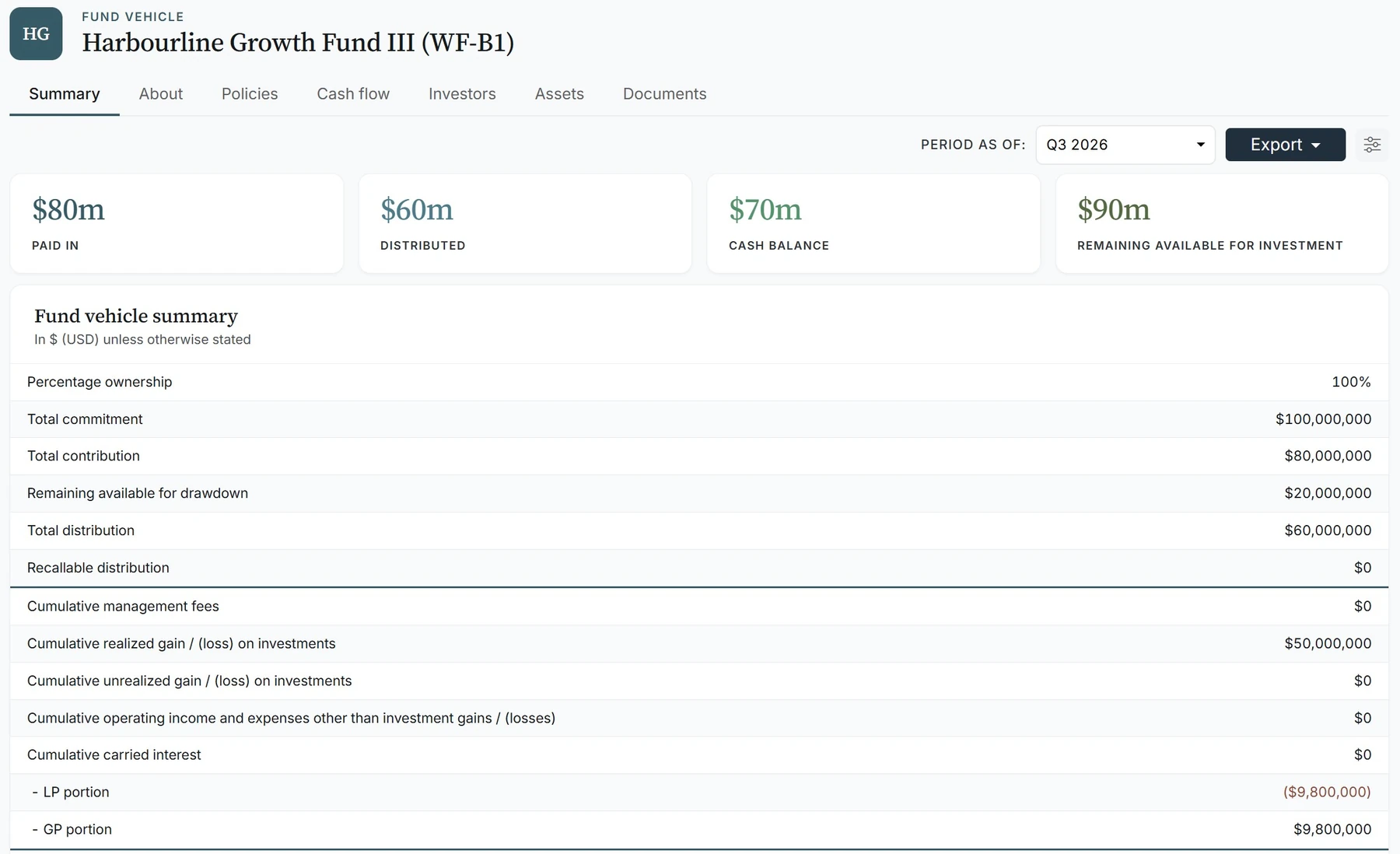
Quantium’s fund accounting module keeps your general ledger, capital accounts, investments and fund terms in a single accounting process. It easily supports a GP fund’s recurring transactions: capital calls, management fees, investor allocations, distributions and carried interest.
Where this goes wrong today
Investors enter at different closings, transfer commitments, opt out of deals and pay different fees.
Each event changes the allocations finance must explain. When the books, the allocation workbook and the waterfall model live in separate files, a partner's question about one payment means rebuilding the answer from scratch.
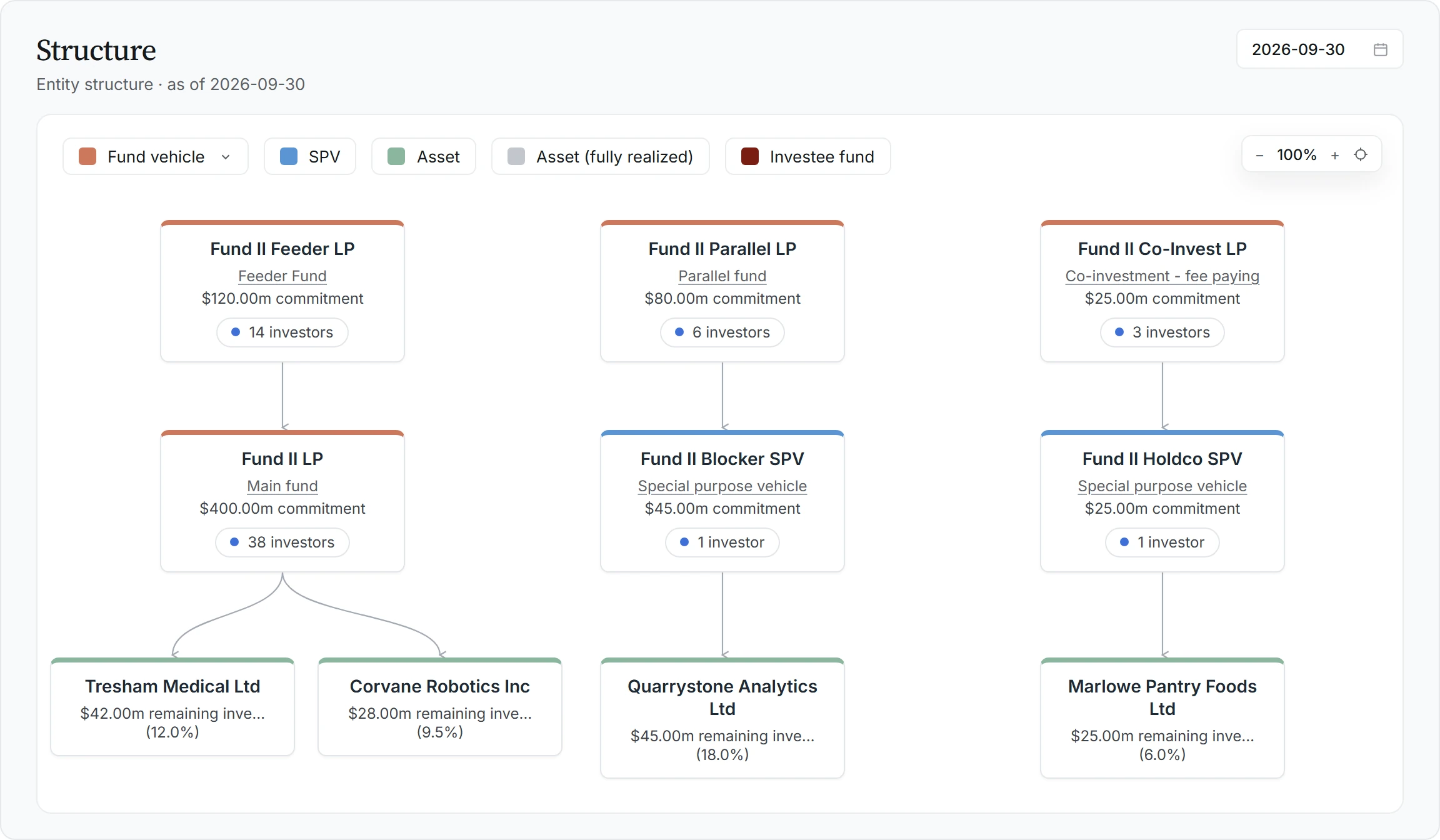
A fund is rarely a single legal entity. Parallel funds, feeder vehicles, blockers, co-investments and SPVs add intercompany movements and ownership relationships that spreadsheets struggle to preserve over time.
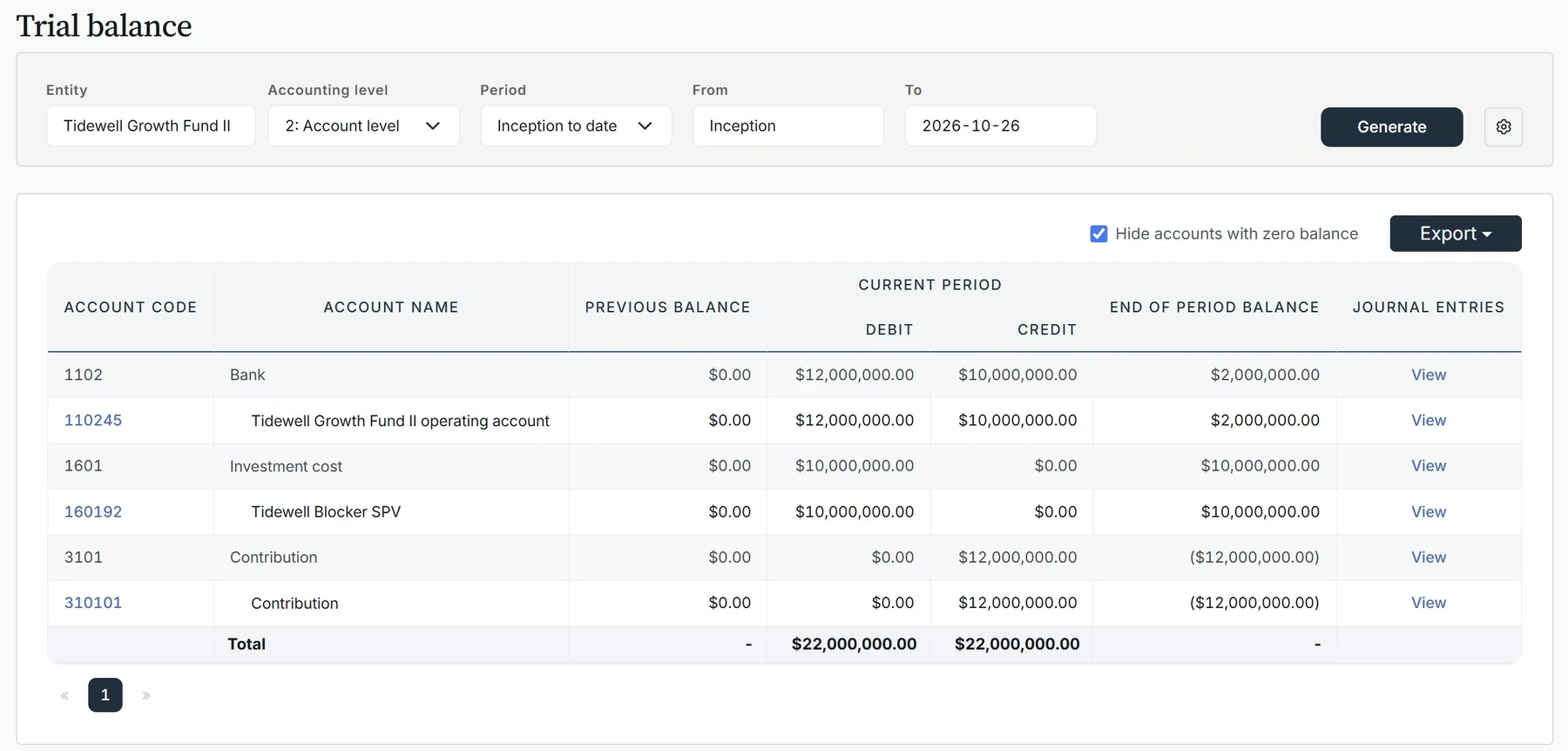
Quantium supports the accounting records and relationships across those entities, including the general ledger, trial balance, investment transactions and partner capital accounts. Review a vehicle on its own or see how it contributes to the wider fund structure.
Four areas cover the work of a private markets fund finance team. Each keeps its detail, and each feeds partner capital accounts and reporting.
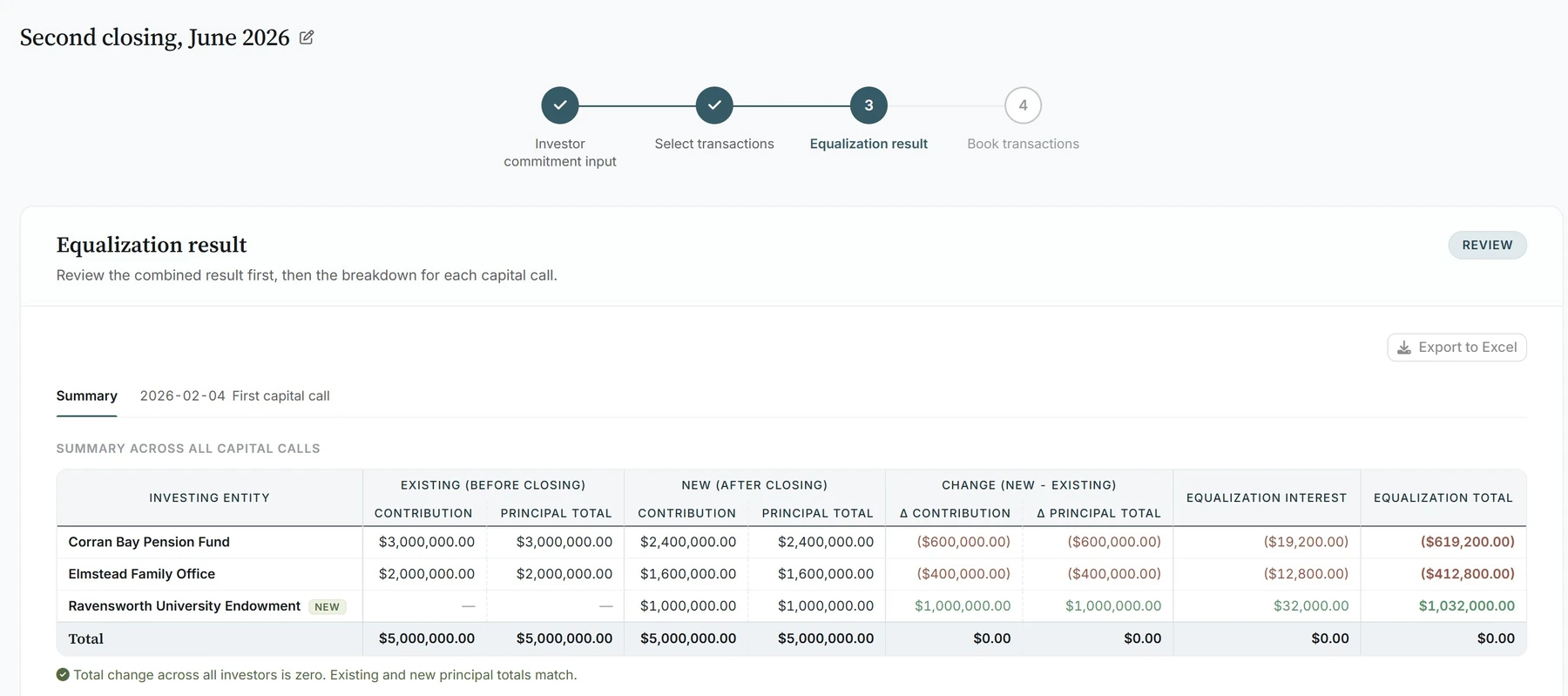
Fund economics rarely apply the same way to every investor. Quantium keeps the terms that drive partner allocations: commitment changes, subsequent closings, transfers, fee discounts and agreed investor-specific rules.
When a capital event, investment transaction or distribution is recorded, finance can review the allocation to each participating account and trace it to the source transaction. Complex rules, including deal participation and opt-outs, are configured and validated against the LPA and side letters.
When a new investor joins at a later closing, every investor should end up having contributed the same share of their commitment. Quantium calculates each investor's equalization amount and the interest due under the LPA, issues the notices and updates the capital accounts.
Every step is kept for review, so finance can show exactly how each investor's position changed at the closing.
Prepare capital calls and distributions with allocation rules tied to the relevant fund and investor records. Generate the resulting notices and track cash movements, so finance can see what was requested, what was received or paid, and what remains outstanding.
This reduces the gap between the accounting transaction and the investor communication. IR and finance give the same answer when an LP questions a notice.
Fund II / Capital
Capital call - distribution
| Investor | Total contribution due | Total contribution paid | Contribution #115 Mar 2026 | Contribution #215 Jun 2026 | Contribution #315 Sep 2026 | Contribution #416 Nov 2026 | |
|---|---|---|---|---|---|---|---|
| Whitcombe Retirement Fund | 17,280,000 | 17,280,000 | Paid & Notified6,000,000 | Paid & Notified4,800,000 | Paid & Notified3,600,000 | Paid2,880,000 | |
| Linford Endowment | 14,400,000 | 12,000,000 | Paid & Notified5,000,000 | Paid & Notified4,000,000 | Paid & Notified3,000,000 | Pending payment2,400,000 | |
| Solvane Growth Fund | 11,520,000 | 9,600,000 | Paid & Notified4,000,000 | Paid & Notified3,200,000 | Paid2,400,000 | Pending payment1,920,000 | |
| Hartwell Family Office | 11,520,000 | 8,400,000 | Paid & Notified4,000,000 | Paid & Notified3,200,000 | Partially paid1,200,000 | Pending payment1,920,000 | |
| Ardenvale Teachers' Retirement | 10,080,000 | 6,300,000 | Paid & Notified3,500,000 | Paid & Notified2,800,000 | Overdue2,100,000 | Pending payment1,680,000 | |
| Granford Insurance | 7,200,000 | 6,000,000 | Paid & Notified2,500,000 | Paid & Notified2,000,000 | Paid / To notify1,500,000 | Pending payment1,200,000 | |
| Total | 72,000,000 | 59,580,000 | 6 of 6 paid25,000,000 | 6 of 6 paid20,000,000 | 4 of 6 paid15,000,000 | 1 of 6 paid12,000,000 |
| Due date | Type | Reference | Total amount | Status |
|---|---|---|---|---|
| 30 Nov 2026 | Distribution | Distribution #3 | 9,000,000 | Scheduled |
| 16 Nov 2026 | Capital call | Call #4 | 12,000,000 | Open |
| 15 Oct 2026 | Distribution | Distribution #2 | 18,750,000 | Complete |
| 15 Sep 2026 | Capital call | Call #3 | 15,000,000 | Overdue |
| 15 Jun 2026 | Capital call | Call #2 | 20,000,000 | Complete |
| 30 Apr 2026 | Distribution | Distribution #1 | 6,250,000 | Complete |
| 15 Mar 2026 | Capital call | Call #1 | 25,000,000 | Complete |
Illustrative example in the layout of Quantium CORE. Statuses follow the payments recorded against each call.
Complex waterfalls should not depend on a spreadsheet whose history is known to one person. Quantium supports configurable whole-fund and deal-by-deal waterfalls, including preferred returns, catch-up and carried-interest allocations within the supported policy scope.
Run a proposed distribution, examine the LP and GP split and review the inputs before approval. Show the workings when partners ask how a payment was calculated. Fund-specific terms are scoped and tested against the actual LPA before a production commitment.
Fund II / Policies
Waterfall policy
Waterfall policy
Waterfall calculation
| Tier | Investors (LP) | GP |
|---|---|---|
| Tier 1Return of paid-in capital | ||
| Tier 2Preferred return | ||
| Tier 3GP catch-up | ||
| Tier 4Residual split 80 / 20 | ||
| Total distribution |
| A | B | C | |
|---|---|---|---|
| 9 | Capital to return | ||
| 10 | Proceeds | ||
| 11 | Remaining NAV | ||
| 12 | Available for distribution | ||
| 13 | Preferred return threshold | ||
| 14 | Return of paid-in capital | ||
| 15 | Preferred return | ||
| 16 | Catch-up available | ||
| 17 | Catch-up target | ||
| 18 | GP catch-up | ||
| 19 | LP catch-up | ||
| 20 | Residual available | ||
| 21 | LP residual split | ||
| 22 | GP residual split | ||
| 23 | Calculated carry after discount |
Illustrative example. Your waterfall follows your LPA; tiers and options beyond the basic policy are set up in the advanced policy and tested against the LPA during implementation.
Not every firm wants full fund accounting in Quantium. Some need one complete record of what they own, across every fund and program.
Quantium keeps that record for direct and fund investments. Each holding is tracked by instrument and tranche, with share count, cost, value, currency and ownership at each date. Use it on its own, or as part of fund accounting in Quantium.
Assets / Larkfield Robotics GmbH
Instrument summary
| Instrument | Investment round | Currency | Initial date | Remaining investment cost | Fair market value | Remaining face value / number of shares | Ownership |
|---|---|---|---|---|---|---|---|
| Preferred shares | Series A | EUR | 15 Mar 2019 | €6,000,000 | €13,500,000 | 1,500,000 | 7.50% |
| Preferred shares | Series B | EUR | 02 Jun 2021 | €4,000,000 | €5,400,000 | 600,000 | 3.00% |
| Preferred shares | Series C | EUR | 30 Sep 2024 | €2,100,000 | €2,700,000 | 300,000 | 1.50% |
| Common shares | Secondary 2025 | EUR | 12 Feb 2025 | €1,200,000 | €1,350,000 | 150,000 | 0.75% |
| Convertible loan | Bridge 2026 | EUR | 20 Jan 2026 | €1,500,000 | €1,500,000 | €1,500,000 | – |
| Total | €14,800,000 | €24,450,000 | 12.75% |
Holdings roll up by fund and investing entity for reporting. Every figure traces back to the transactions behind it.
Client exampleInvestment book of record (IBOR) for a $3B multi-asset investor
Fund expenses, management fees and intercompany balances often touch more than one entity. Track the fund's investment entities and related balances in Quantium.
The management-company posting and intercompany reconciliation workflow is agreed during scoping. Some automated cross-entity postings need specific configuration.
Review source transactions, fee calculations, investor allocations and closing balances through the books and trial balance.
Use approved information to prepare financial and investor reporting without rebuilding a separate reporting spreadsheet every quarter.
The statements, schedules and notices come from the same ledger and investor allocations as the accounts. Templates are set up once and refreshed each period, so the pack matches the books.
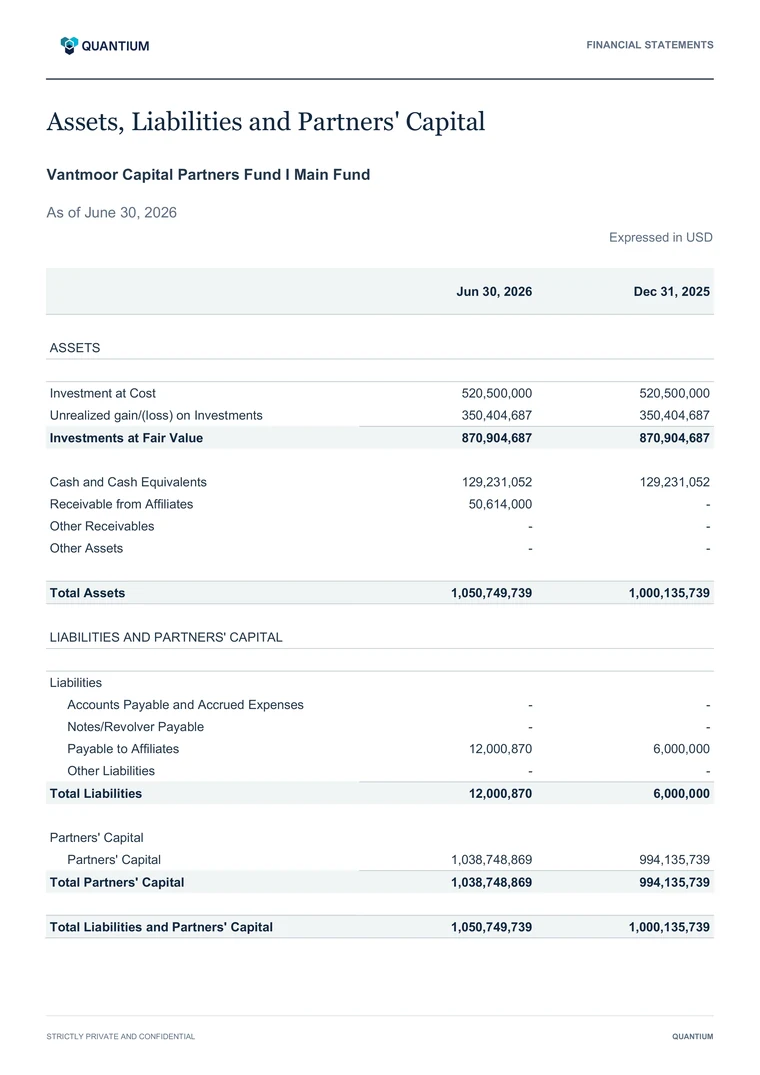
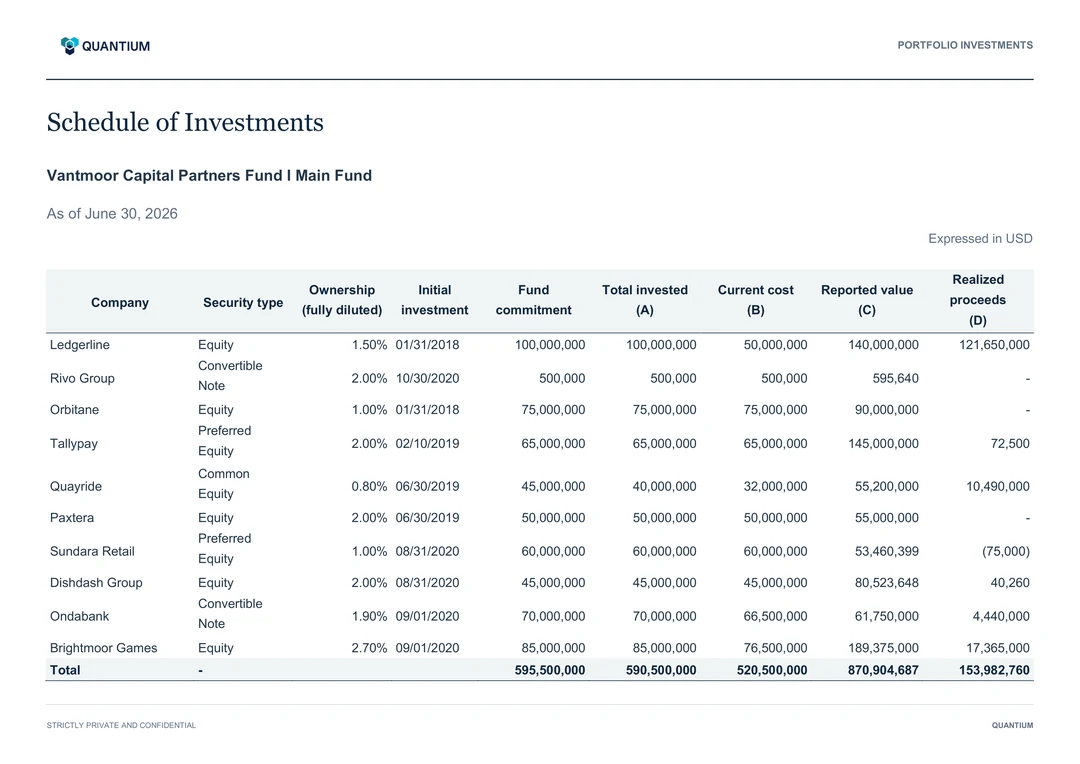
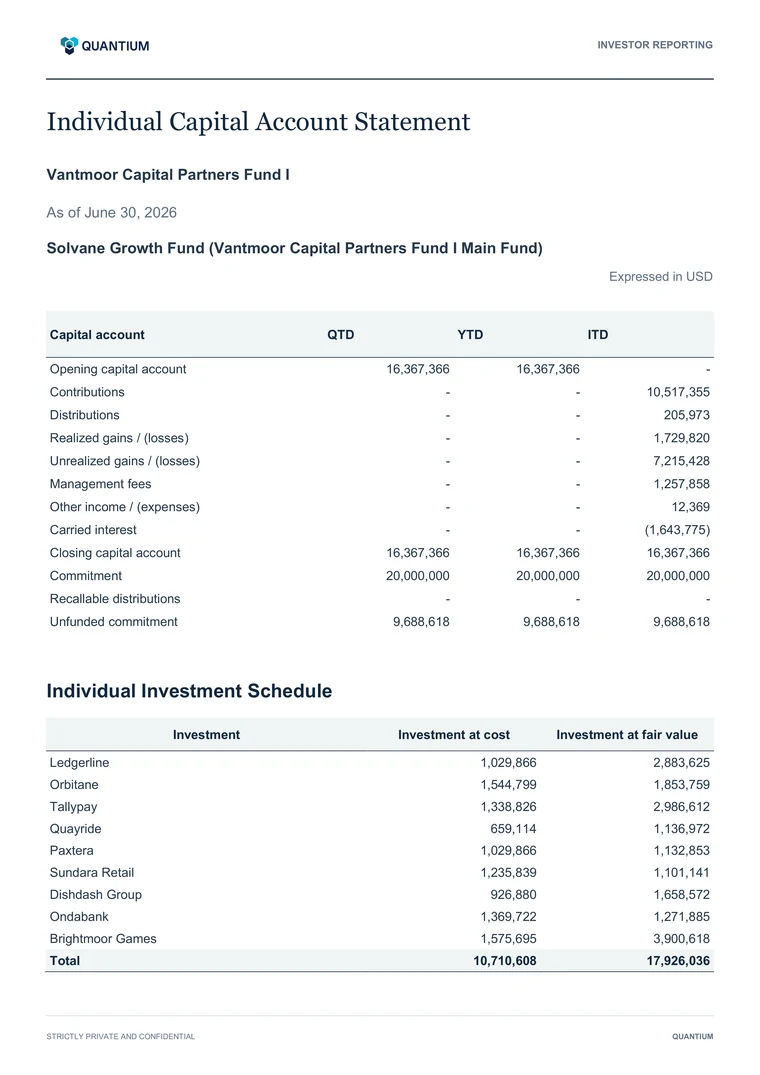
Q2 2026 reporting pack, fictional names
Smartfin
Private Equity
Fund-specific waterfall rules and investor distribution calculations, moved out of spreadsheets. Told by Smartfin's CFO.
$5B private equity buyout manager
How an established manager connects employee carry allocations, GP co-investment positions and participant reporting.

Brandon Capital
Venture Capital
The Australian life sciences investor selected Quantium for fund accounting and investor reporting across a multi-vehicle fund structure, with portfolio monitoring also in the program.
Selection announcement, not a results study.
Quantium Fund Accounting is a general ledger and partnership accounting system for private markets funds. It runs journals, capital calls and distributions, investor allocations, management fees, waterfalls and carried interest, and produces capital account statements and financial statements from the same records. It suits managers who keep the books in-house and administrators who run them for clients.
Yes. An operating model can combine internally administered funds on Quantium with externally administered legacy funds, depending on scope.
Yes. Quantium can keep the investment book of record on its own: every direct and fund investment by instrument and tranche, with share counts, cost, value, currency and ownership. Fund accounting can be added later.
Yes, within supported fee policies. Investor-specific rates, fee discounts and offsets are configured from your LPA and side letters and validated before go-live.
Yes. Quantium supports investor-level terms and allocation workflows, including transfers and different closings. Complex fund-specific rules are configured and validated during implementation.
Yes. Waterfall workings and supporting transactions can be reviewed before a distribution is approved.
It can. The accounting records feed Quantium's own investor reporting and portal workflows. The exact modules included depend on the proposal.
Walk through a closing, an investor transfer or a distribution using the terms that matter to your finance team.